You Can’t Always Measure the Value of Working Out Loud

2shoes
Recently, I was disappointed that my personal blog did not seem to be generating any meaningful metrics, and my spirits were lifted when I remembered that one day I had shared this story out loud, and something cool happened afterwards:

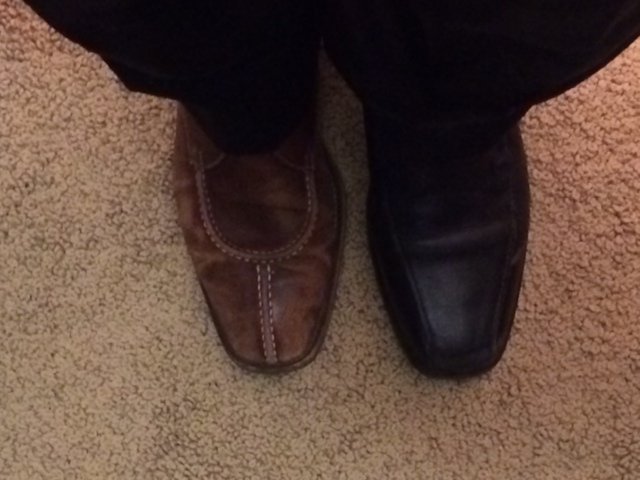
As I got out of my car this morning, I looked down at my shoes. “That’s not something you see everyday,” I said out loud. On my left foot, I had a black shoe on. On my right, a brown one. All I could do was laugh. Didn’t get upset. Or mad. Just laughed. Perfect shoes for an imperfect moment!
My 1st grader has become somewhat of a permanent roommate in a sleeping bag on the floor of our bedroom. He even refers to it as “our room” in his conversations. Pretty soon he’ll start to tape up posters on the wall, I think.
Since he was still sleeping, I put on my shoes in the dark (obviously!), and didn’t notice until I got out of my car. So to solve the problem I went to Marshalls–not open yet. Daytons? Nope. How about that fancy new shoe shop in the skyway? Guy in there drinking coffee, but door locked. So I went to Target. Meronas for $25 saved the day. Sometimes life throws you a curveball–how you choose to deal with it is up to you. Today I chose to just roll with it, make fun of myself, and share my story of imperfection with you today. At least now I have a spare pair of dress shoes!

The most powerful comment or “like” I ever received was neither a comment nor a like. It wasn’t even out loud. Someone told me privately that on this particular day, their spouse was having a real hard time. He said he shared my story with her to let her know that everyone has things go sideways from time to time. She laughed when he showed her my picture and subsequently recovered. He wanted me to know—personally–that my words helped.
That was pretty humbling to me.

I am a fledgling blogger. For any others out there starting to share your stories and work out loud, don’t get caught up in the number of comments or likes. Your impact through writing can’t always be measured.

A Change in Perspective

A lesson I have learned recently is that your present perspective is just one of many. But think about how current issues can demand much of our time, emotion, and energy. We can be so focused on the here and now that we forget that in a couple weeks it will be the there and then. Disappointment 2 weeks ago that something you wanted didn’t work out becomes the liberation that you might be destined for different things.

I think in life this happens to us more than we think. Often we have a belated appreciation for things. The same experiences, people, situations look so different with even a slight change in our circumstances. That tough and difficult boss now seems appropriately demanding; that stressful and never-ending project seems to have stretched you out of your comfort zone; that difficult and flagrant co-worker now seems to have challenged your assumptions and biases. Ideally it would help if in the midst of whatever is happening we could remember that the present perspective is just one of many.

(Inspired by the Daily Reflection–Fr. Don Talafous, St. John’s University)

Are You Afraid to Work Out Loud?

Many have heard the benefits of Working Out Loud as they relate to connecting with others and as I’ve written, to create more Leadership Impressions.

So why doesn’t everyone do it?

I think many are afraid.

Afraid of the perceptions it could create. Afraid of being controversial. Afraid of having your thoughts, God forbid, written down.

At some point, however, those fears that paralyze us from working out loud will actually cause us to become irrelevant.

Work will require us to be so fast that playing this game of Switzerland just won’t scale. Teams will require us to be responsive, stand for something, debate, challenge, and continuously improve. Employers will expect employees, including leaders, to create communities that foster open collaboration. Customers will want vendors to acknowledge (and more importantly) quickly fix problems. Trying to hide a defect for fear of customer backlash will result in customer backlash for hiding the defect.

I feel a shift coming. Our own future relevancy will require us to change the way we work and change the way we lead.

Old Tapes

For those of you old enough to remember, tapes preceded CD’s for consuming music.  You could also record stuff.  Recorded stuff could be played back, over and over again–play and rewind, play and rewind.

When the concept of playing something back, over and over again, is applied to a previous, and often times negative experience or association about people, the metaphor “old tapes” gets used.  Think about it, do any of the statements below sound familiar?

“She manages up well, but not side-by-side or below.”

“He’s more about the numbers than the people.”

“He’s more concerned with his own career than anything else.”

We all have done it. It doesn’t feel to me that any real good can come of it.  It’s what the author Brenda Frederickson calls “gratuitous negativity.”–negativity for nagativity’s sake.

So why do we do it?

Some of us like to talk and contribute.  When asked a question about someone, we feel like we need to blurt out what is top of mind, instead of nothing. And while it is top of our mind, it could have happened 4 years ago.  But yet we still say it as if we know it to be true today (when we don’t).  Another reason might be that we don’t like the other person (for whatever reason) or we feel insecure. Playing back old tapes validates those negative feelings within us.

Receivers of this type of messaging should make a conscious effort to try and qualify the statements as true.  “Are you sure?”  “When was the last time you observed this?”  “Have you directly talked to the person recently?”

When you hear people citing old tapes, those questions are good guidelines to use. It’s also OK, in my opinion, to let people say “I don’t have any recent observations on that person.”

Brian Buford once said, “If you haven’t observed someone in at least two, preferably three, different (and recent) settings, don’t give feedback.  You always can share perceptions, but that’s different from feedback.  Ram Charan believes that superior talent assessment results from suspending judgment and intentional observation.  Only through deep observation of one’s actions and decisions can we confirm or disconfirm our hypotheses.  Then we can share informed feedback.” (parentheses mine)

Assume good intent, people can change.  I saw a post I liked recently saying, “you don’t know what battles I’m working through.” Essentially, there are times where we do or say things because of something larger going on that others don’t know about. Ask them questions, seek to understand, and collect multiple data points.  Providing real, recent, and relevant context is what matters.

Image

I Believe in You

I keep coming back to these 4 words in my leadership journey. They are simple and clear. And powerful. I guarantee that my best work relationships have those 4 words resonate with both parties. I also think it’s true in other leadership capacities. I’ve seen recently a son of mine perform at a much higher level in basketball this spring with a new coach. I asked him why and he said, “coach believes in me.”

Conversely, my poorest relationships didn’t have those 4 words going both ways. A lot of it was me. I tend to have high expectations for myself and for others. I found myself disappointed one day and a friend told me, “Omar, there you go again, you and your high expectations. If you would just lower them you’d be a lot happier.”

Truth is, I can’t. For me, having high expectations of myself and others can work, and when it does, we all believe in each other. Then we have that solid foundation to do extraordinary things. Getting to that place, however, requires some hard work and sweat equity. No one said it would be easy. If you are willing to take it, head on, you will see a huge upside. You might have some hard conversations, or not see “eye to eye” on some things. But who said we’re always supposed to see “eye to eye” on everything?

But I also found that I was not saying those 4 words enough when I truly felt them. I was missing opportunities to engage and inspire people just because I was focused on other things. I’ve learned to pause more and recognize when that feeling is really there. Taking that time has resulted in some great work. My advice to you: Say those 4 simple words to the people working hard every day around you. It means a lot.

Transparency, not Compliance

Driving change is a challenging task. With so many different nuances to the type of change you are trying to drive, there is clearly no one size fits all approach. I’m a big fan of measurable goals at the macro level, where all participants understand very specifically how they are aligning to those goals. I say measurable because there are things that we should and can measure. Any continuous improvement process (e.g., ITIL) uses measurable goals that should and can be measured to baseline organizational performance and then subsequently drive improvements. I’ll take a “quality improved by 40% as measured by x” success statement any day over a “quality got better” statement.

So how do you effectively drive organizational-wide initiatives that have measurable goals?

My evolved answer is transparency. Let me give you a little background.

Earlier in my career, it was all about compliance. What’s your goal? Where are you at (what’s the number?) Who’s hitting it? Who is not? Get the folks who are not hitting the number to hit the number. Done deal, rinse and repeat.

Compliance, while often effective at “hitting the number”, is generally criticized as having the potential to drive the wrong behavior. And, to many, it just doesn’t feel that great. Reaching out to people and saying, “Well, you’re team is at 30% and the goal is 80%. You know this report is going out to Management” may be a quick way to get their attention, but it’s also a quick way to have partners get frustrated and question the value of what you are trying to do.

Now enter the value shift.

Transparency is just a much better way to think about things. If we are setting organizational goals that are measureable, it’s still important to understand why you may or may not be attaining those goals. Think about branding the reports you use as transparency reports instead of compliance reports. This now allows you to create transparency to where your opportunities are. And instead of feeling like there are punitive penalties, you just create awareness and an understanding (aka transparency) to the challenges the teams are faced with which will in turn create a dialog of understanding and a plan of action. Continuous improvement can still happen because people know where they stand and why things are the way that they are. You diffuse a natural tendency to be defensive.

The “what” is still achieved, but the “how” is even better. For me, I’ve really worked hard at this value shift. When you get labeled as a “numbers guy” people sometimes mis-interpret your intentions as just wanting to “hit the numbers.” But in reality, the spirit of what I try to do is to help people understand what they are shooting for, where they are at, and along the way develop a greater understanding for their business and how to think about what they could do to continuously improve.

Picking up Where You Left Off

Recently, I had lunch with a former co-worker whom I’d consider a friend. We had not seen each other for several months. It was a nice lunch and I recall us both commenting that it was like we could just pick up where we left off (from the last time we talked). We didn’t have to start from scratch, or lay any of the ground work—that had already been done. He’s the type of person where while I’d prefer to see him face-to-face, I’d accept an email or quick phone call or IM to “talk” to him.

In the workplace, we often start up new relationships. I think of having an end goal to some day be able to “pick up where you left off” is a good way to frame up the desired outcome. Making that investment of time with each new person is something I’m committed to do. It’s only after having shared experiences and time can you get it to the point of being able to pick up where you left off. Think about your relationships that are this strong. What would you recommend to folks starting new work relationships as they begin this journey? We can’t under estimate the power of those connections and need to appreciate that there will be some sweat equity in the creation of those relationships.

Loose Change Lessons

In 1986 I lived in Glasgow, Scotland with my parents and sister Susan while Dad was a visiting professor at the University of Glasgow for a semester. We lived in a flat and had no car. We walked or took public transportation everywhere. On the way to school there was an ice cream store. I don’t remember the name of it but one of the treats they had was an ice cream sandwich of sorts called a “Wafer”. Essentially home-made ice cream packed between 2 wafer cookies of sorts. It was delicious.

Kids like ice cream. I was a kid. But I don’t remember getting an ice cream every time I walked by. What I do remember is that Dad has always been proficient at finding loose change on the ground. Eyes peeled to the ground, he could find a coin in the smallest of spaces. Most days, he would come home and deposit that day’s change in a jar. When the grand total in the jar equaled enough to buy 4 wafers, off we went to the ice cream store. Then, the process would begin again.

Hundreds of times walking by=no ice cream

A couple times with a jar of change=appreciated ice cream

I was reminded of this story when in Chicago with my kids on a trip. We had eaten breakfast in the hotel room and my kids had been given a glass of Archer farms apple juice which we had brought from home. I noticed as we left the room that some of the juice had gone unfinished, which is fairly normal. But at least we had attempted to meet their basic needs. Within the hour, we were waiting to get the pass we had purchased for touring the sights and I decided to buy my wife and I a cup of coffee. All four kids in tow, we waited in line and I ordered the coffees.

Suddenly, the kids just expected to also get—of all things—a juice box of apple juice. Not the cheap variety mind you, but $2 a pop. That’s 2 bucks times 4 kids. My initial reaction was “no”. “No” is a complete sentence. Unpopular decision. We parents are faced with these decisions all the time. “Oh come on, we’re on a vacation.” or “pick your battles.”

I talked to my kids about this blog/story and for me it comes down to appreciation. If you are privileged in life, then showing appreciation can neutralize your behaviors of entitlement. My Dad’s lesson in loose change was an intentional teaching point. I’m sure had I asked for some impromptu ice cream he would have bought it for me, but I never expected it. Whether it is ice cream or apple juice, sometimes waiting for enough loose change might just teach you a valuable lesson in appreciation.

Don’t Be Afraid of Open Calendar TIme

I realize the topic of meetings is not a new one to talk about.

Sometimes I wonder what is wrong with me that my calendar has some open availability on it. Ask anyone, in any company, how it’s going and inevitably they will say, “I’m super busy.” A glance at the calendar and you’d likely see the majority of time between 8-5 consumed with meetings.

I think it’s safe to say that knowledge workers today meet a lot. While that’s not always a ‘bad’ thing, I challenge you to think about the following:

If you have a matter to discuss or need a question answered…..is “setting up a meeting” the only way?

Take my personal experience as a view. Historically speaking, scheduling a meeting (or series of) was the default response in follow up to most of my interactions with people. I felt like I couldn’t get my head above water. I was accepting every meeting request—no matter what. The impact was back-to-back meetings, with no breaks, very little desk time and no time for informal interactions with my team. In fact, I’d have to read my calendar right before a meeting and try to remember what it was about. As I got better about really trying to understand which meetings were the right meetings for me to attend, and asking better questions about the purpose of the meetings, I started noticing that I would (politely) decline a few meetings, or have a delegate attend (instead of both of us). This resulted in a little more discretionary time. Time which has allowed me to explore other ways to connect with people on a more ad-hoc basis, and overall… to be more responsive than I had been while doing things the ‘old’ way.

When I talk to folks about their calendars, and why they are feeling “so busy”, here is a Q and A I go through to help get to the “why”:

Q1: Why are you so busy?

A1: I’m booked from 8-5

Q2: Why are you booked from 8-5?

A2: I have to meet with so many people

Q3: Why do you have meet with so many people?

A3: To collaborate on a wide variety of topics

Q4: Why does your initial collaboration on a topic require a calendar meeting?

A4: Getting people in a room helps people focus on the topic at hand–setting up a meeting is how I’ve always collaborated with people, and I can ensure answers to my questions.

Q5: I would agree that at times, that is the most appropriate tool in your collaboration tool box. Have you ever tried using ad-hoc collaboration or asking a couple questions prior to just accepting or setting up a meeting?

A5: I’m not sure, tell me more…

Meetings are expensive. People in a room for an hour adds up. Some extreme companies track this, and there are calculators to compute the “cost of a meeting”. I’m not suggesting we do this—at all—(I think my Dad used to refer to ideas like that as “lead balloons”) but rather just acknowledge the fact that this collaboration technique—getting people in a room—may be more expensive than collaborating on an ad-hoc basis. And, it’s a choice we make. But my focus has been on asking the question:

Do we need to meet on this yet?

Today’s technology collaboration tools like IM and social communities, now more than ever, allow for more efficient ad-hoc collaboration that may allow you to avoid taking the step requiring you to setup a physical meeting to collaborate on a topic. And while our children can’t relate, there is always the technique of picking up the phone.

These ad-hoc collaboration tools are all effective ways to either a) get an answer to the question without meeting or b) confirm that a meeting is the next logical tool to use. Perhaps the answer to a clarifying question, just by asking, would eliminate the need to meet at all.

I’ve had 2 examples—this week—where simply collaborating ad-hoc to clarify something eliminated the need for folks to meet. And everyone was satisfied with that. Are you changing the way you work to open up some calendar time? If so, would love to hear your story.

Betting a Lunch–The Power of a Burrito

Many of us are competitive. People that know me well have always said that if you want me to do something, tell me that I can’t do it.

“You’ll never be able to get that tennis ball out of the gutter hole on the 2nd story of the house…”

Oh yeah, I can do that no problem, I say to myself and then almost kill myself doing it.

If you are an Omar blog follower, you’ve read some of my thoughts around speculation. People speculate all the time why we can or cannot do something. So I’ve been kicking around strategies to deal with speculative people’s ideas and have resorted to a tried and true method of speculation standoff.

I’ve started making bets with people. Betting lunches.

You’d be surprised at how much interest you get when a burrito is on the line.

Recently, one of our team members was speculating about a new process that was going to deliver this and that to us. So I said, “great, the first time what you’re telling me will happen actually happens, I’ll buy you lunch.” Sure enough, he later came back with a big smile and said, “where are you taking me to lunch?” He was proud that he did it and made it happen.

I think this gave him some focus to “put his money where his mouth is” and try even harder at executing what he was saying because this gave him some motivation, as something tangible—even if it were just a burrito—was on the line. He had to walk the walk, and it gave us a fun forum to do good work, which in the end is the most important point. I, like someone did with me and the clogged gutter, used his competitiveness to drive execution. And, it was fun!

Honestly I hope most of the time that I lose the bets like this.

Try it sometime–I bet you a burrito it will work! Really.

(This blog, and the content within, is not endorsed by any Burrito company who may or may not have a long line at lunch time